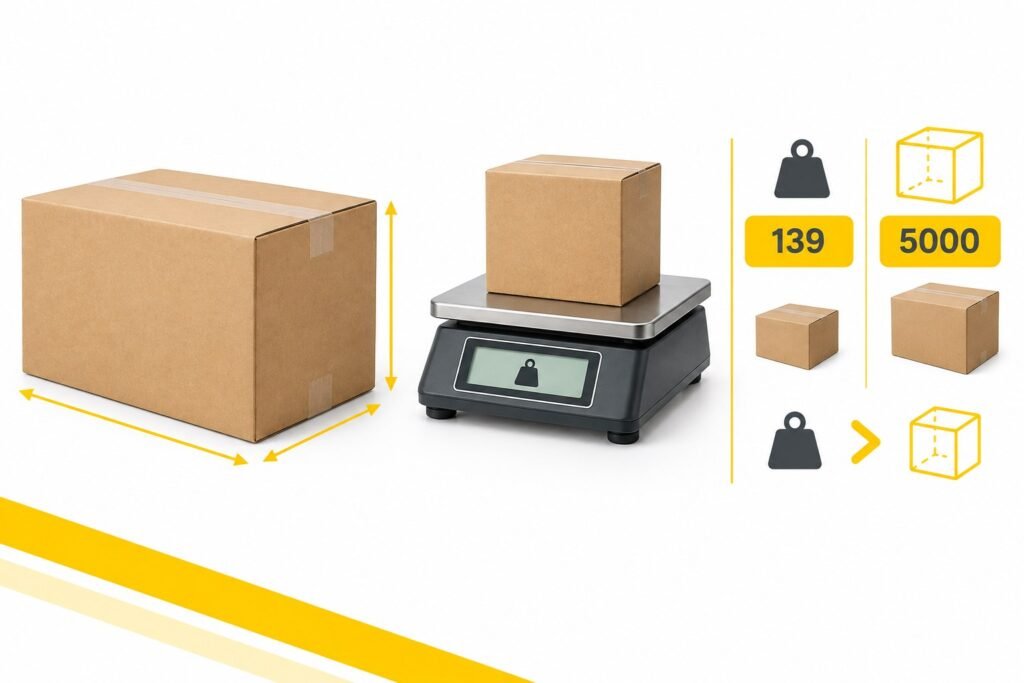
Quick answer: DHL Express commonly calculates volumetric weight by dividing package volume by 5,000 when dimensions are in centimeters and weight is in kilograms, or by 139 when dimensions are in inches and weight is in pounds. DHL then compares that result with the package’s actual scale weight; the greater value is the chargeable weight used for many Express shipments.
If you already know your packed dimensions and scale weight, use the DHL Volumetric Weight Calculator to calculate the result instantly. Use this guide when you want to understand why the 5,000 and 139 divisors appear, which one matches your units, and how dimensional weight can change a DHL shipping quote.
DHL volumetric weight formula at a glance
| Measurement system | Formula | Result |
|---|---|---|
| Metric | Length × Width × Height (cm) ÷ 5,000 | Volumetric weight in kg |
| Imperial | Length × Width × Height (in) ÷ 139 | Volumetric weight in lb |
The two divisors serve the same purpose in different unit systems. Do not choose 5,000 or 139 based on destination alone; choose the formula that matches the dimensions and weight units you are using and confirm the exact DHL product rules before purchasing a label.
Metric formula
For metric dimensions, the common DHL Express formula is length × width × height in centimeters ÷ 5,000. A 60 × 40 × 35 cm carton equals 84,000 cm³, producing 16.8 kg of volumetric weight.
Imperial formula
For inches and pounds, DHL Express publishes a 139 divisor in its rate-quote guidance. The two divisors are unit-system equivalents used to express the same idea: low-density shipments consume aircraft or network capacity relative to their scale weight.
For DHL Express specifically, use the DHL Volumetric Weight Calculator to calculate dimensional and estimated chargeable weight with the 5,000 or 139 divisor. You can also use the general Volumetric Weight Calculator for custom divisors and the Billable Weight Calculator to compare volumetric and actual weight.
DHL eCommerce can use different factors
Do not assume every DHL product uses the same divisor. DHL eCommerce U.S., for example, publishes different chargeable-weight factors for some products. Always match the divisor to the exact DHL service and market you are using.
Reduce chargeable weight with packaging density
If volumetric weight is higher than actual weight, reducing empty space can lower the chargeable figure. Test smaller cartons with the Shipping Box Size Optimizer.
Worked examples: 5,000 vs 139
Metric example
A parcel measuring 50 × 40 × 30 cm has a volume of 60,000 cm³. Divide 60,000 by 5,000 and the DHL volumetric weight is 12 kg. If the actual scale weight is 9 kg, the dimensional figure is higher, so 12 kg becomes the planning estimate for chargeable weight.
Imperial example
A carton measuring 20 × 16 × 12 in has a volume of 3,840 in³. Divide 3,840 by 139 and the volumetric weight is about 27.6 lb. If the actual parcel weighs 18 lb, the volumetric result is the higher figure.
Common DHL dimensional-weight mistakes
- Mixing units: do not enter inches into the 5,000 formula or centimeters into the 139 formula.
- Measuring the product instead of the packed carton: carrier billing is based on the finished shipment dimensions.
- Ignoring bulges and outer packaging: measure the largest external points of the parcel.
- Using actual weight only: a light but bulky carton can be billed at a much higher dimensional weight.
- Assuming every DHL service uses identical rules: DHL Express and DHL eCommerce products can differ, so verify the specific service.
How to lower DHL chargeable weight
If dimensional weight is consistently higher than scale weight, the most useful lever is usually package volume. Test smaller cartons, reduce unnecessary void fill, and standardize box sizes around real product dimensions. The Shipping Box Size Optimizer can help model that change before you alter packaging.
For carrier comparisons, also review DHL vs FedEx vs UPS for international shipping. A lower dimensional weight can change which carrier or service is cheapest on a specific lane. For next-year budgeting, see the DHL Express 2027 rate increase guide and the DHL 2027 shipping budget.
Frequently asked questions
Is DHL volumetric weight the same as dimensional weight?
Yes. DHL commonly uses the term volumetric weight, while many U.S. shippers use dimensional or DIM weight. Both describe a billing weight based on package volume.
Does DHL use 5000 or 139?
Use 5,000 when the calculation is in centimeters and kilograms, and 139 when the calculation is in inches and pounds. Confirm the exact service rules for the shipment you are quoting.
Does DHL charge actual weight or volumetric weight?
For applicable DHL Express shipments, the chargeable basis is generally the greater of actual weight and volumetric weight.
Can a smaller box reduce DHL shipping cost?
Potentially. If volumetric weight is driving the chargeable weight, reducing the finished carton dimensions can reduce the billing weight and may lower the quoted transportation cost.
Official DHL sources
DHL’s own guidance states the metric formula as length × width × height divided by 5,000 and explains that the greater of actual and volumetric weight becomes chargeable weight. DHL Express also publishes the 139 in³/lb equivalent for inch-pound calculations.
Carrier rules can change by product and market. Verify the exact DHL service before operational use.
PackToolbox guides are built around stated formulas, practical examples and source checks for changeable carrier, freight and logistics rules. Calculators are planning aids; final requirements should be verified with the relevant carrier or service provider.