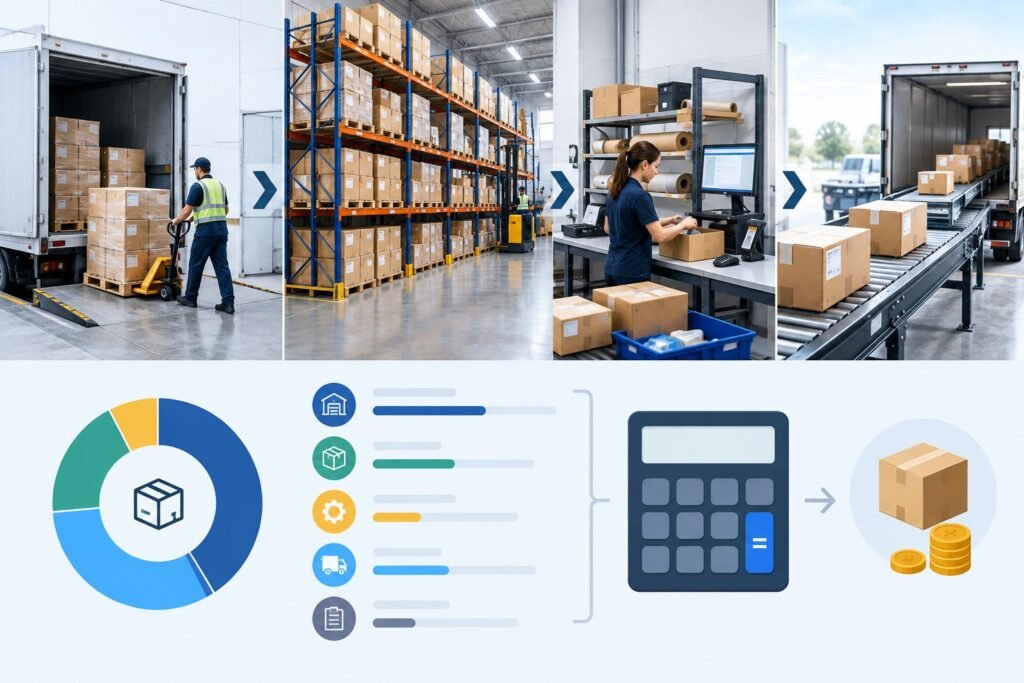
Quick answer: the most useful 3PL pricing metric is the fully loaded fulfillment cost per shipped order, not the advertised first-pick fee. A credible 3PL cost model should combine receiving, storage, pick-and-pack, packaging, returns, account or software fees, minimums, special projects and outbound shipping where applicable.
Use the 3PL Cost Calculator to model these charges before comparing providers. The simplest formula is: total monthly 3PL spend ÷ shipped orders = average 3PL cost per order. For a more useful decision, keep warehouse fulfillment fees and carrier transportation visible as separate line items as well as showing the fully loaded total.
Build the full cost stack
Typical categories include receiving, storage, pick-and-pack, packaging materials, outbound shipping, account or platform fees, kitting, returns and exception charges. Not every 3PL uses the same structure, so normalize quotes into the same categories.
Convert monthly costs to cost per order
Add the monthly costs that belong to fulfillment, then divide by shipped orders. Keep product cost separate. If shipping is billed separately, calculate it independently and then add it back for a fully loaded view.
Use the 3PL Cost Calculator to combine storage, receiving, pick-and-pack, packaging, returns, account fees and outbound shipping into one monthly model and cost-per-order estimate. The Packaging Cost Calculator helps benchmark packaging and labor assumptions, while the shipping cost per order framework helps separate transportation spend.
Watch for volume assumptions
A quote based on 10,000 monthly orders may not represent your economics at 2,000 orders. Model minimums, storage seasonality and order-profile changes.
Compare packaging quality too
A 3PL that uses oversized standard cartons can increase dimensional weight even if its pick fee is low. Ask how carton selection works and compare common package sizes with the Box Size Optimizer.
Use a weighted order profile
Model single-item, multi-item, fragile and oversized orders separately, then weight them by expected volume. That produces a more credible blended cost than applying one average fee to every order.
The decision should balance cost, service level, geographic reach, systems, inventory accuracy and operational flexibility. The cheapest quoted 3PL is not necessarily the lowest-cost fulfillment operation.
Normalize every 3PL quote into the same worksheet
| Cost category | Common pricing basis | What to ask |
|---|---|---|
| Receiving | Hour, pallet, carton or unit | Are appointments or special projects extra? |
| Storage | Pallet, bin, shelf or cubic space | How is peak inventory measured? |
| Pick and pack | Order + additional item | What counts as an extra pick? |
| Packaging | Material or bundled rate | Can custom cartons be used? |
| Returns | Per return or processing step | Are inspection and restocking separate? |
| Account/platform | Monthly minimum or software fee | What happens below volume commitments? |
Worked blended-cost example
Suppose a 3PL charges $2,000 in monthly fixed/minimum fees, $4,000 in pick-pack and receiving, $1,500 in packaging, and $7,500 in outbound shipping for 1,500 orders. The fully loaded total is $15,000, or $10 per order. Looking only at the pick-pack charge would show $2.67 and materially understate the operating cost.
Questions to include in a 3PL RFP
- How are storage minimums and seasonal peaks charged?
- Which carton sizes are stocked and how is box selection made?
- Can our own negotiated carrier accounts be used?
- How are address corrections, special handling and carrier adjustments passed through?
- What inventory-accuracy SLA or reporting is provided?
- What are the fees for returns, kitting, inserts and special projects?
- How quickly can inventory be transferred out if we leave?
How to compare 3PL quotes before signing
Do not compare two providers from their headline fulfillment fee alone. Rebuild both quotes using the same monthly order volume, average units per order, SKU count, storage footprint, returns rate and peak-season assumptions. Then compare the resulting cost per order.
- Normalize receiving into the same monthly inbound volume.
- Normalize storage into the provider’s actual billing unit: pallet, bin, shelf or cubic space.
- Model first-item and additional-item pick fees using your real basket size.
- Add packaging, inserts, kitting and special handling rather than assuming they are included.
- Add monthly minimums, account fees, software and onboarding charges.
- Keep postage and carrier markups visible instead of burying them inside the warehouse fee.
- Run a normal month, a peak month and a low-volume month.
For the detailed fee structures behind those inputs, see 3PL pricing models, 3PL storage fees, 3PL receiving fees, and pick-and-pack fees.
3PL cost per order: what buyers should optimize
A lower warehouse fee does not automatically mean a lower total fulfillment cost. A provider can be more expensive on pick-and-pack but cheaper overall because of better storage density, packaging choices, zone distribution or carrier economics. For ecommerce brands comparing fulfillment companies, the commercial question is the total delivered cost per order at the service level you actually need.
Shopify’s fulfillment-cost guidance similarly separates expenses such as receiving, storage, picking and packing, shipping and returns. Use external benchmarks as a checklist, but use your own order profile for the actual provider decision.
Frequently asked questions
Should outbound shipping be included in 3PL cost per order?
Yes for a fully loaded comparison. You can also track fulfillment fees and transportation separately so each cost driver remains visible.
Are 3PL quotes directly comparable?
Rarely. Fee names, minimums and packaging assumptions differ, so normalize every proposal into the same order-volume and cost categories.
Can a 3PL reduce parcel cost even if fulfillment fees are higher?
Potentially. Better geographic positioning, carrier discounts or packaging can offset higher pick-pack fees. Model the total order economics.
What volume should I use when comparing quotes?
Use current, peak and expected-growth scenarios. A single optimistic volume forecast can make minimums and storage costs look artificially cheap.
Related guides
PackToolbox guides are built around stated formulas, practical examples and source checks for changeable carrier, freight and logistics rules. Calculators are planning aids; final requirements should be verified with the relevant carrier or service provider.