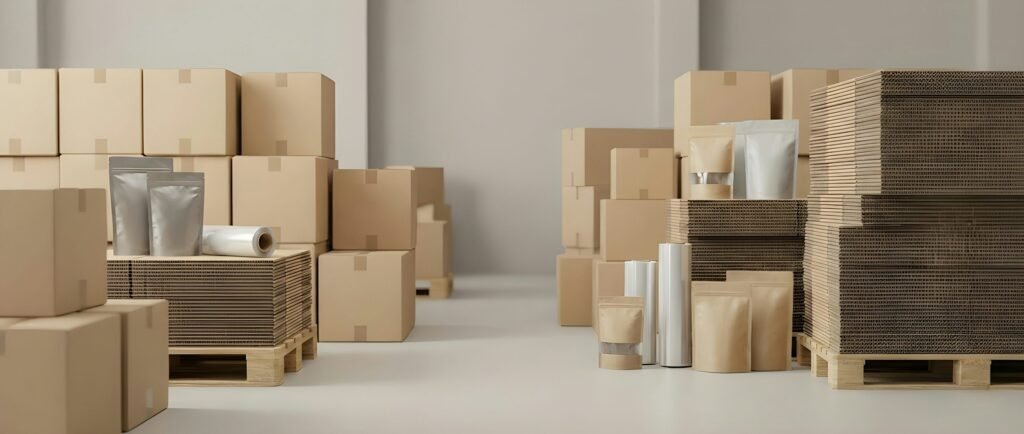
Void fill is the material used to stop products from moving inside a shipping box. It sounds simple, but the wrong choice can increase dimensional weight, slow packing, add material cost or still fail to protect the product.
What void fill is supposed to do
Void fill is mainly about blocking and bracing. It fills empty space so the product does not build momentum and strike the carton walls. Some materials also provide cushioning, but not all void fill should be treated as impact protection.
Paper vs air pillows vs foam
| Material | Best for | Main advantage | Main limitation |
|---|---|---|---|
| Paper | General ecommerce, mixed SKUs | Flexible, recyclable in many streams | Can add weight and labor |
| Air pillows | Large empty spaces around light products | Very light, fast at scale | Not ideal for sharp/heavy items |
| Foam | Fragile or high-value products | High cushioning potential | Higher material/storage complexity |
| Molded inserts | Repeat SKUs | Consistent fit and presentation | Tooling and SKU specificity |
How void fill affects dimensional weight
The material itself may be cheap, but the space it requires can be expensive. If oversized cartons need large amounts of filler, you can end up paying to ship air. FedEx explicitly recommends right-sizing packages to reduce empty space and potential dimensional-weight cost.
Before changing void fill, test a smaller carton with the Shipping Box Size Optimizer. A smaller safe carton can reduce both filler use and billable weight.
Choose by product risk, not material price
A ceramic mug, a bottle of supplements and a metal machine part may all fit the same carton dimensions, but they do not need the same protection. Ask what failure you are trying to prevent: movement, abrasion, puncture, corner impact or shock.
PackToolbox decision framework
- Measure empty space. If the box is mostly air, fix carton size first.
- Identify product fragility. Lightweight, non-fragile products need less cushioning than glass or electronics.
- Check edges. Sharp or dense products can puncture air pillows.
- Measure pack time. A cheaper material can cost more in labor.
- Test the finished pack. Shake tests and controlled drop testing reveal movement that is not obvious on the bench.
Worked example
A fulfillment team uses a 16 × 12 × 10 in box for a product that safely fits in a 14 × 10 × 8 in box. The larger carton needs three handfuls of paper. The smaller box needs one. The savings are not only paper: package volume falls from 1,920 to 1,120 cubic inches, which can materially reduce DIM weight depending on the service.
Sustainability considerations
Material choice should consider local recycling reality, not only marketing labels. Paper may fit familiar recycling streams, while film-based air pillows may require store-drop or specialist recycling depending on region. A smaller package with less material is often the most straightforward improvement.
Frequently asked questions
Are air pillows good for heavy products?
Usually not as the primary restraint for dense or sharp items. They can burst or shift. Dense cushioning, corrugated inserts or engineered foam may be more appropriate.
Can I eliminate void fill completely?
Yes, if the product is immobilized safely by a right-sized carton, insert or molded pack. The goal is product control, not material for its own sake.
What should I optimize first: box size or filler?
Usually box size. Excessive void fill often indicates that the carton is too large.
Compare void fill on total packed-order cost
Material price per foot or per sheet is only one part of the decision. Add pack time, storage space, equipment cost, carton size, damage rate and disposal/recycling handling. An inexpensive filler that requires a larger carton can increase carrier cost enough to overwhelm the material saving.
A practical comparison uses the same SKU and shipment volume for each option. Record average material used per order, packing seconds, finished box dimensions and damage rate. Convert each into a per-order cost, then compare the full result rather than the purchase price of the filler.
Test changes with real distribution conditions
When changing from foam to paper or from paper to air pillows, do not assume the materials are interchangeable. Build test packs using the actual product and carton, then evaluate movement, compression and drop/impact exposure appropriate to the distribution channel. A change that works for a lightweight apparel accessory may be unsuitable for glass or dense metal parts.
For high-volume products, run a controlled pilot before changing the whole operation. Track claims and returns for the test group alongside packaging cost. The goal is the lowest total cost that still protects the product—not the smallest amount of packaging material.
Sources
PackToolbox guides are built around stated formulas, practical examples and source checks for changeable carrier, freight and logistics rules. Calculators are planning aids; final requirements should be verified with the relevant carrier or service provider.