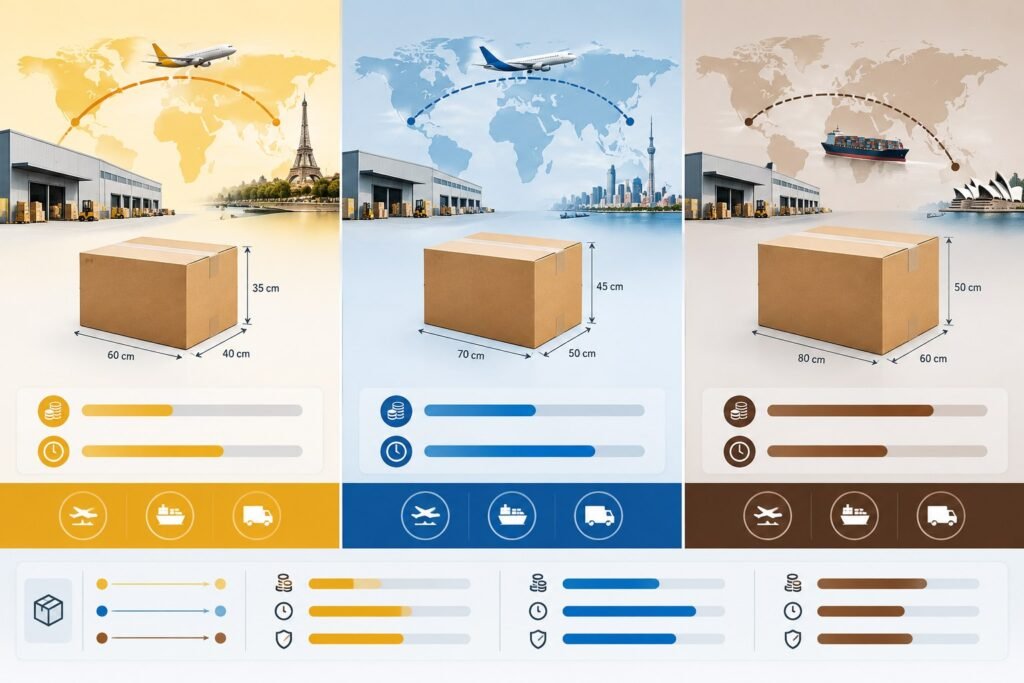
There is no universal answer to whether DHL, FedEx or UPS is cheapest for international shipping. The winning carrier can change by origin, destination, package dimensions, billing weight, delivery commitment, customs profile, pickup arrangement and—most importantly for regular shippers—your negotiated account rates.
For ecommerce and B2B shippers in 2026, the better approach is to compare the fully loaded cost for representative lanes instead of choosing a carrier from a generic rate chart.
DHL vs FedEx vs UPS: what to compare
| Factor | Why it matters | What to collect |
|---|---|---|
| Origin/destination lane | Carrier network economics vary by route | 5–10 high-volume country/postal-code pairs |
| Delivery speed | Express vs economy changes base rate | Required transit window |
| Billing weight | Dimensional weight can exceed scale weight | Packed L×W×H + actual weight |
| Remote/extended area | Final-mile accessorials can dominate small orders | Representative postal codes |
| Fuel/demand fees | Variable and seasonal charges alter total cost | Current surcharge tables |
| Customs/brokerage | Import processing differs by shipment and country | Commodity, value, Incoterm and destination |
| Account discount | Contract pricing can overwhelm public-rate comparisons | Your actual account quote |
DHL Express
DHL Express is heavily focused on international time-definite shipping. Its U.S. quote tool supports international packages and pallets and itemizes factors such as destination, dimensions, service speed, customs-related costs and surcharges. DHL states that its Express network serves more than 220 countries and territories.
DHL Express also publishes a detailed U.S. surcharge schedule. In 2026, examples include Remote Area Delivery/Pickup, additional handling, address correction, fuel and seasonal Demand Surcharges. That transparency is useful, but it also means a base-rate comparison alone is incomplete.
For volumetric weight, DHL Express documents the familiar 5,000 cm/kg or 139 in/lb divisor. Read our DHL 5000 vs 139 volumetric-weight guide for the formula and examples, then use the DHL Volumetric Weight Calculator before comparing quotes.
FedEx
FedEx provides broad international parcel and freight coverage with multiple delivery-speed tiers. For a serious comparison, use FedEx’s current account or spot quote for the exact origin, destination, dimensions and service level. Do not assume a public list rate is representative of what a business account will pay.
Pay particular attention to dimensional-weight rules, additional-handling or oversize triggers, fuel, delivery-area charges, declared value and customs-related fees. PackToolbox already maintains a FedEx Additional Handling and Oversize guide for those package-design issues.
UPS
UPS likewise publishes current rate and service guides and updates accessorials during the year. Its U.S. rate page shows that demand, international processing, disbursement and other fees can change independently of base transportation rates. Account discounts and lane mix again matter more than a simplistic list-rate comparison.
For parcel design, see our UPS Additional Handling and Large Package guide.
A practical carrier-bid method
- Export 30–90 days of shipment history. Keep origin, destination country/postal code, actual weight, dimensions and service used.
- Create a representative basket. Choose shipments that cover your highest-volume lanes plus expensive edge cases.
- Normalize billing weight. Recalculate dimensional weight consistently so packaging differences do not distort the comparison.
- Quote all three carriers on the same day. Use the same service objective and declared shipment data.
- Add accessorials. Remote area, fuel, demand, additional handling, brokerage and correction fees belong in the model.
- Compare delivered cost and service together. A $3 saving is not useful if the service misses your customer promise or creates more exceptions.
Worked example: why the winner can change
Suppose a U.S. seller ships three recurring profiles: a 2 lb compact parcel to London, a 12 lb bulky parcel to Sydney and a 30 lb B2B shipment to a remote Canadian postal code. The carrier that wins London may not win Sydney; the Canadian shipment may be dominated by a remote-area or extended-area fee. One average international rate therefore hides the actual economics.
The right output is a lane table showing carrier × service × fully loaded cost × transit commitment. Repeat it quarterly or whenever contracts and surcharges change.
Which carrier should a small ecommerce brand start with?
Start with the carrier that produces the best combination of delivered cost, service coverage, pickup convenience and support for your highest-volume lanes. If international shipping becomes meaningful, a multi-carrier setup can reduce dependence on one network and lets you route around expensive lanes.
Frequently asked questions
Is DHL always cheaper internationally?
No. DHL can be highly competitive on many international lanes, but price depends on shipment profile, route and account terms. Quote your real shipments.
Is FedEx or UPS better for Canada?
There is no universal winner. Compare your exact postal codes, service levels, brokerage setup, account discounts and accessorials.
Should I compare retail rates?
Retail rates can be useful for occasional shippers, but regular businesses should compare actual account pricing because discounts can materially change the ranking.
What is the biggest mistake in carrier comparisons?
Comparing base rates without dimensional weight and surcharges. That can make the apparently cheapest carrier the most expensive after invoicing.
Sources and live quote pages
- DHL U.S. international quote tool
- DHL Express U.S. surcharges
- UPS U.S. rates and current fee updates
- FedEx rate tools
Carrier prices and surcharges change frequently. Use current live quotes for purchasing decisions.
PackToolbox guides are built around stated formulas, practical examples and source checks for changeable carrier, freight and logistics rules. Calculators are planning aids; final requirements should be verified with the relevant carrier or service provider.